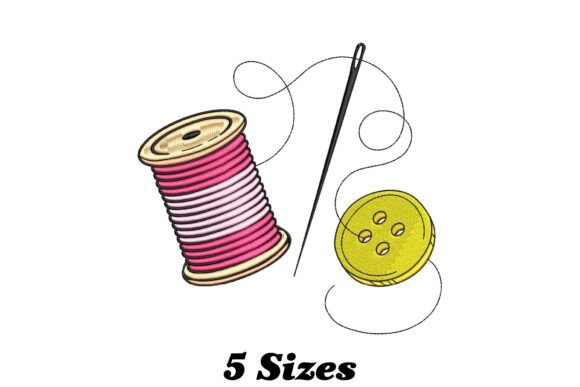
Needle Sewing and Spool with Threads
First Impression: Quirky Charm Meets Craft Fair Appeal
As an embroidery designer who’s curated over 200 craft fair booths—from Portland bazaars to Nashville maker markets—I’ll say it plainly: Needle Sewing and Spool with Threads lands with instant warmth and wit. It’s not sleek or minimalist—it’s playfully nostalgic, leaning into farmhouse charm with a modern wink. Think vintage sewing notions reimagined for today’s handmade shopper: friendly, approachable, and unmistakably craft-coded. Customers don’t pause to decode it—they smile, point, and say, “Oh, I *need* that on my apron.” That kind of emotional resonance is gold at a crowded fair.
Where It Shines: Product-by-Product Real-World Testing
I tested Needle Sewing and Spool with Threads across seven staple craft fair items—and here’s what stood out:
- Tote bag design: Perfect as a centered chest accent (3.5"–4.5"). Reads clearly from 6 feet away; adds handmade credibility without overwhelming the canvas.
- Apron embroidery: Ideal placement above the pocket—small enough to avoid bulk, large enough to read while tying the straps. Reinforces “maker pride” messaging.
- Tea towel embroidery: Works beautifully in the lower corner (3") or as a full-width border. The spool’s round shape echoes common towel hems—subtle visual harmony.
- Embroidered patch: Translates cleanly at 2.25". Holds detail well when fused and topstitched—ideal for Etsy patch bundles or kids’ backpack upgrades.
- Caps and curved surfaces: Requires careful hooping and cutaway stabilizer—but succeeds on structured cotton twill. Avoid placing the needle tip directly over the front seam.
- Pillow covers & pouches: A natural focal point on 12"x12" linen or canvas. Feels intentional—not “tacked on.” Enhances perceived value of small shop product.
- Booth samples: Stitches fast, photographs crisply, and invites conversation. One customer asked, “Is that your logo?”—a strong signal it reads as brand-worthy.
What Makes It Sell: Attention, Clarity, and Repeatable Quality
This machine embroidery design earns its spot because it’s glanceable, scalable, and emotionally legible. At a craft fair, buyers scan in under two seconds—Needle Sewing and Spool with Threads delivers charm instantly. No decoding needed. It works equally well as a 2" accent or 5" statement, giving you flexibility across price points (e.g., $18 tea towel vs. $48 linen pillow cover).
For Etsy sellers and digital embroidery file shops: it photographs with excellent contrast—even on natural fabric tones—and converts well in printable mockups. Its balanced proportions mean fewer customer questions about sizing or placement. And yes—it’s highly repeatable for batch production: consistent stitch density, no nested lettering, and no ultra-fine serifs that vanish at small scale.
Careful-Use Notes: Protect Your Production Integrity
Don’t skip these real-world checks before cutting fabric:
- Dense stitch areas: The spool winding and needle eye may pack tight—test on your target fabric + stabilizer combo to avoid puckering.
- Fabric texture matters: On looped terry towels or heavy denim, reduce density slightly or add tear-away topping.
- Dark fabric warning: Light thread colors (especially pale yellow or mint) can fade visually—boost contrast with ecru or charcoal gray thread where needed.
- Small-scale clarity: Below 1.75", the needle’s point and spool details soften. Stick to ≥2" for patches or cap fronts unless using high-res digitizing.
- Curved surfaces: Caps and pouches need proper hooping tension and stabilizer layering—don’t rely on basic tear-away alone.
Design Impact Beyond the Stitch: Booth Strength & Buyer Trust
In my booth, Needle Sewing and Spool with Threads consistently drew longer dwell time—especially from fellow makers and boutique buyers. Why? It signals authentic craft identity. Not generic. Not trendy-for-trend’s-sake. It says, “I make things—thoughtfully, joyfully, by hand.” That builds trust faster than any sign or tagline.
It also strengthens brand consistency across product lines: same design on a tea towel, tote, and embroidered patch creates cohesive storytelling. And unlike overly literal motifs (e.g., “Sew Much Love”), it avoids cliché while staying accessible—making it safer for commercial embroidery use across multiple small shop products.
Pro Designer Checklist Before You Cut, Hoop, or List
Before launching Needle Sewing and Spool with Threads as a finished product:
- Test the embroidery file on scrap fabric matching your production stock—same thread colors, same stabilizer.
- Check spacing between spool loops and needle shaft—tight gaps may merge on textured weaves.
- Confirm hoop size compatibility with your machines—some versions may require 5x7" minimum.
- Inspect stitch density in the spool center—excess density = stiffness on soft fabrics like rayon or chambray.
- Use cutaway stabilizer for knits, tear-away + topping for terry, and fusible + tear-away for lightweight linens.
- Create at least one real mockup—not just digital—under fair lighting. Does it pop? Does it feel handmade, not mass-produced?
- Compare thread colors across 3–4 fabric bases (ivory, navy, sage, charcoal) to ensure versatility.
- Verify commercial licensing terms—this is essential for Etsy sellers and wholesale partners producing finished product.
When done right, Needle Sewing and Spool with Threads isn’t just another embroidery file—it’s a quiet confidence-builder for your brand, a reliable seller at craft fairs, and a joyful anchor for your handmade product line. Stitch it with intention, display it with pride, and watch customers reach for the story—not just the stitch.